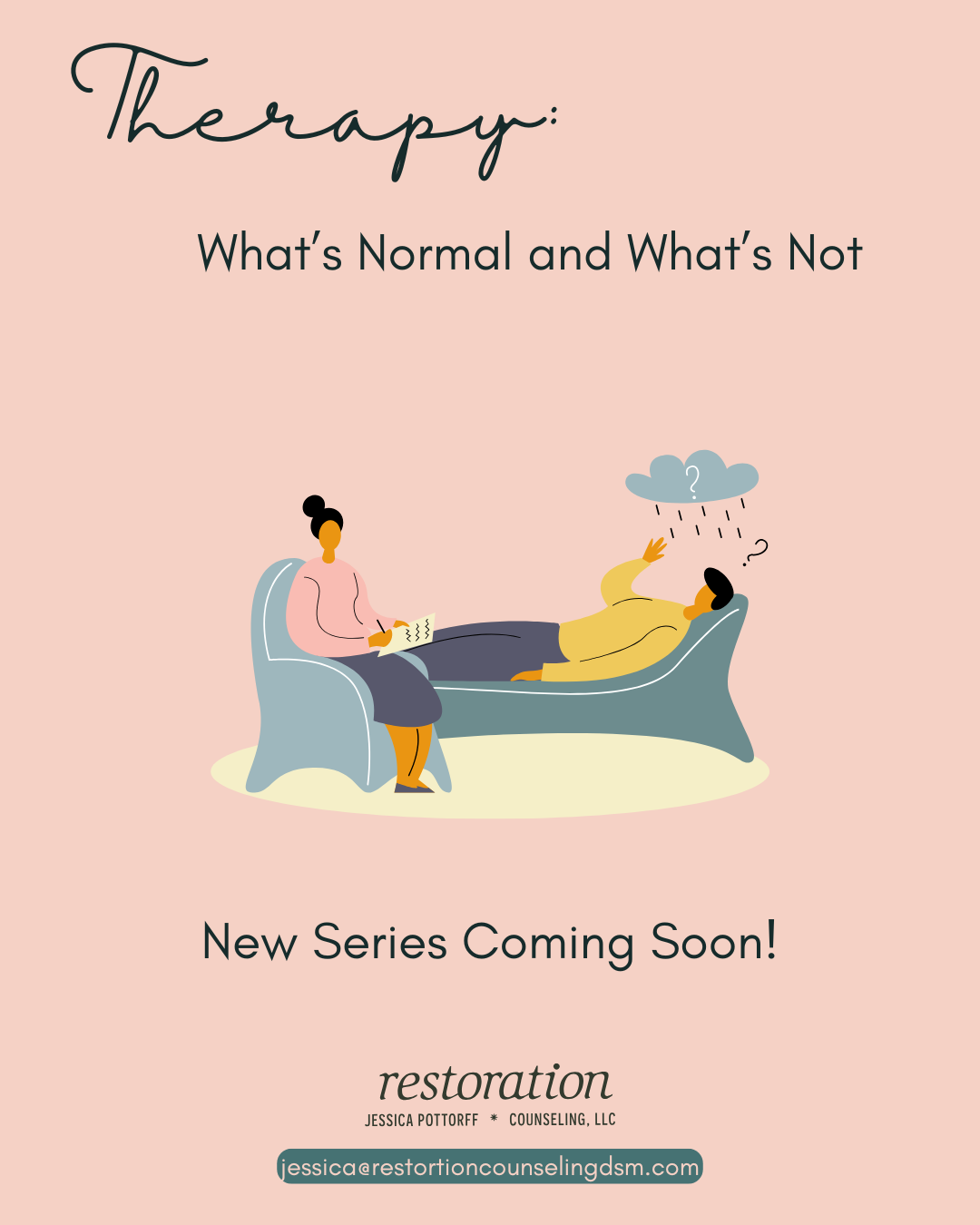
Therapy: What’s Normal and what’s not
Hello, friends. It’s Jessica here, your therapist at Restoration Counseling LLC, sitting with a cup of coffee and a thought that has been stirring in me for a while now.
Over the years, I’ve noticed something quietly significant in the therapy room.
Clients will lean forward slightly, lower their voice just a bit, and ask,
“Is this normal?”
Sometimes they’re asking about their own emotions.
Sometimes they’re asking about relationship patterns.
And sometimes… they’re asking about therapy itself.
And that question matters more than we often realize.
Starting therapy is a vulnerable act. You walk into a room and open parts of your story that you’ve guarded carefully. You assume the space is safe. You assume the structure is solid. You assume the professional sitting across from you is holding steady boundaries that protect you.
Most people don’t know what therapy is supposed to look like.
Why would you?
Unless you’ve been trained in ethics codes and clinical standards, you wouldn’t automatically know where healthy structure ends and blurred boundaries begin.
But here’s what I want you to hear clearly:
Therapy is not casual conversation.
It is not a friendship.
It is not a loosely defined support system.
It is a licensed healthcare service with guardrails. And those guardrails are not restrictive. They are protective.
When therapy is practiced well, it has form. It has clarity. It has steady edges.
You should feel:
Safe in the privacy of the space.
Clear about confidentiality.
Certain about your therapist’s role.
Free to focus on your healing without managing someone else’s emotions.
If something ever feels confusing, inconsistent, or blurred, that feeling deserves attention. Not panic. Not accusation. Just awareness.
In this new series, we’re going to gently walk through common therapy scenarios and ask one simple question:
Is this normal?
Some answers will reassure you.
Some may sharpen your discernment.
All of them are meant to empower you.
My heart in this is not to criticize other clinicians. It is to protect clients.
Because informed clients are protected clients.
Therapy should feel steady enough to hold your grief.
Structured enough to support your growth.
Clear enough that you’re never left guessing where you stand.
Ethical therapy isn’t rare.
It’s the standard.
And you deserve nothing less.
Email me Jessica@RestorationCounselingDSM.com, visit my website, www.restorationcounselingdsm.com or text me at (515) 518-0681 to get started in therapy today!